
AI, ML and LLMs: a practical starting point
Beginner · Foundations
“I want to learn AI, but every roadmap starts with twenty things I do not know.”
Start with a task you can recognise
Imagine a college help desk. One program routes a message containing “library” to the library team. A second learns to classify requests from labelled examples. A third drafts a reply in natural language. They may look similar to the person using them, but their engineering problems are different.
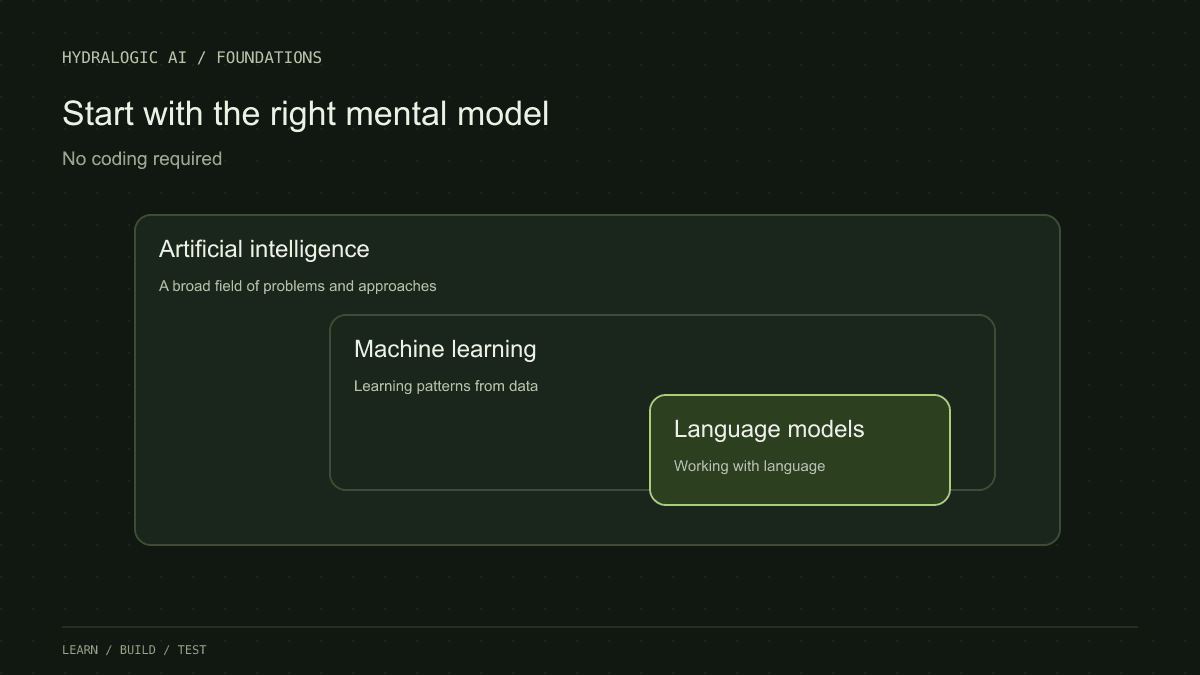
AI is the broad field. Machine learning is an approach in which models learn patterns from data. A large language model is a kind of model trained on large amounts of language data and used for tasks involving language. These terms are related; they are not three competing products to install.
Separate training from using a model
Training changes a model through a learning process. Inference uses a trained model to produce an output. When you ask a hosted language model a question, you are usually performing inference, not training a new model. Adding a document to a prompt does not by itself update the model’s weights.
That distinction makes a first project manageable. You can explore an existing model before studying how to train one. Understanding training remains valuable, especially if you want to work on model development, but it is a different learning track from building an application around a model.
Choose an exercise for your starting point
No coding yet? Take a short public course description and ask a chat assistant to turn it into a checklist. Keep the original beside the answer and mark every unsupported addition. This teaches you to inspect outputs without spending your first afternoon on setup.
Know basic Python or JavaScript? Repeat the same task through a small server-side program. Focus on input, output and errors. Already building software? Add a small test set, latency measurements and a clear behaviour for missing information. The task can stay the same while your engineering responsibility grows.
Try this: three versions of a campus assistant
Use invented, non-sensitive notices. Write down what each version receives and what it must return. Do not begin with a chatbot that answers everything. Your first useful result is a task with a boundary.
- Rules: route a notice by a keyword you choose.
- Prediction: describe the labelled examples a classifier would need.
- Generation: draft a summary that contains only facts in the notice.
A checkpoint before the next tutorial
You should be able to explain which part is a model and which part is your application. You should also be able to name one failure you saw and how you detected it. A convincing-looking answer is not evidence that a system is reliable.
Save your inputs, outputs and observations in a short README. That record is more useful than a collection of course completion screenshots: it shows what you tried, what happened, and what you would test next.
Written by Hydralogic AI, not yet reviewed by a second person. Checked at primary sources, linked below.
A little practice. A clearer next step.
Twelve free questions with explanations. Choose your track. No account, no card.